

Electromagnetic Simulation for Conductors and Resistors
Design and analyze conductors and resistors with EM simulation
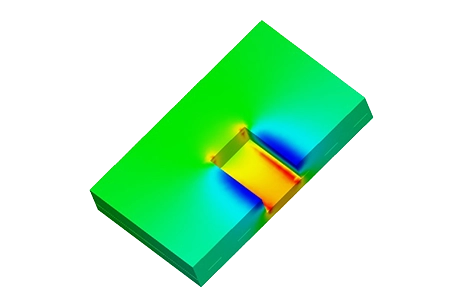
This note uses EMWorks Electric Conduction to compute resistance, electric field, current density and potential in a laser-trimmed resistor backed by a conductive slab under fixed voltage.
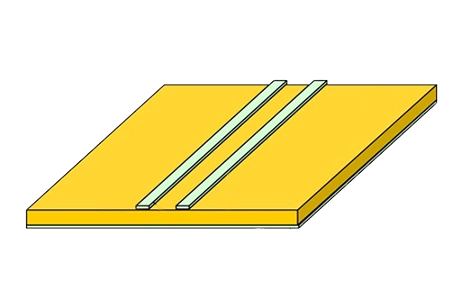
This application note uses EMWorks to extract parasitic capacitance, DC and AC resistance, and inductance from a PCB with parallel copper traces on an FR4 substrate. Electrostatic, magnetostatic, and AC magnetic studies are combined to compute R, L, and C, including skin effect via a reduced 1/20 model, and the results are validated against published reference data for EMI modeling.
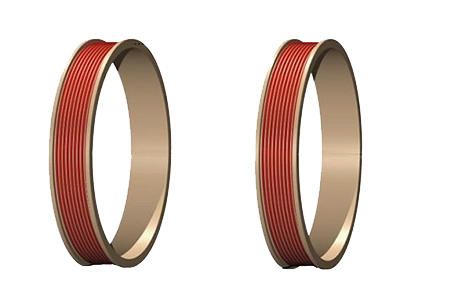
Helmholtz coils generate highly uniform magnetic fields for biomagnetic and seed research. This example shows how to model, mesh, and simulate AC and DC excitation to validate field uniformity along the coil axis.
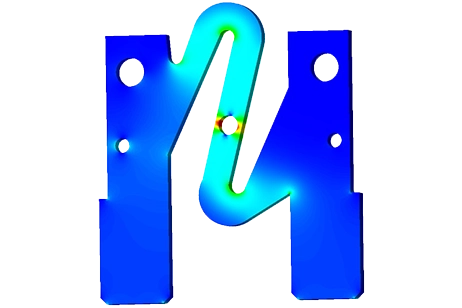
Analyze how an automotive fuse responds to overload by tracking electric field, current density, and temperature rise in the zinc element. Use electrothermal simulation to predict melting behavior, locate hotspots, and verify that fuse ratings provide reliable circuit protection under fault conditions.
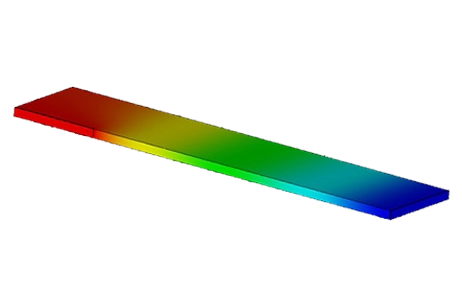
This example shows how to model a thin film resistor in EMAG, assign material properties, apply fixed voltages, refine the mesh, and extract resistance that closely matches the analytical solution.
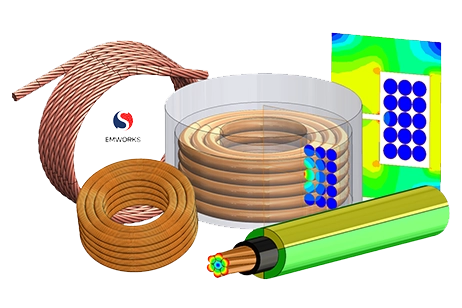
Litz wire design is tricky at high frequencies, where skin and proximity effects can ruin efficiency. This article shows how EMWorks electromagnetic simulation helps you analyze AC losses, compare Litz vs solid conductors, choose strand size and count, and validate insulation stress to build better high-frequency coils and transformers.